
When someone dies without leaving a valid Will, their estate still needs to be dealt with properly. Banks, building societies, pension providers, investment companies and other organisations may require legal proof that someone has the authority to deal with the deceased person’s assets.
This is where a Grant of Letters of Administration comes in.
If you are looking for information about how to apply for letters of administration in England, or you need help administering an estate where there is no Will, understanding the process is important.
At Preuveneers LLP, our probate solicitors provide practical support to administrators, beneficiaries and families dealing with estates following a death. We can assist with applying for a Grant of Letters of Administration, inheritance tax matters and the administration of the estate.
What is a Grant of Letters of Administration?
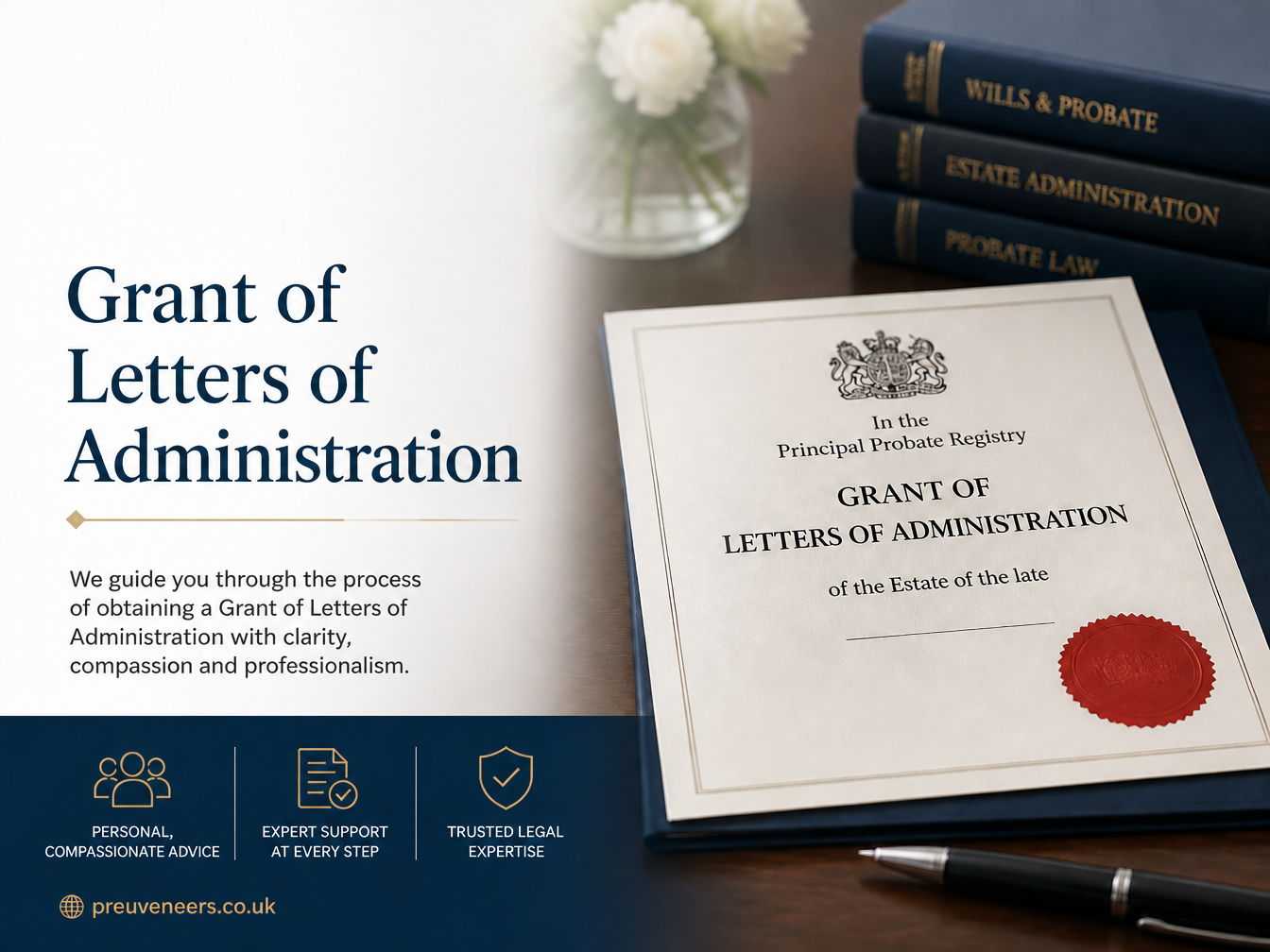
A Grant of Letters of Administration is a legal document issued by the Probate Registry which gives an administrator authority to deal with the estate of someone who has died without a valid Will.
It is one type of grant of representation.
In England and Wales, the most common forms are:
- A Grant of Probate, where there is a valid Will and an executor applies.
- A Grant of Letters of Administration, where someone dies without a Will.
- Letters of Administration with Will Annexed, where there is a Will but there is no executor able or willing to act.
HMRC explains that letters of administration provide the authority for an administrator to act on behalf of an intestate estate.
If you need a solicitor for letters of administration in South London, professional advice can help you establish who is entitled to apply and what needs to be done before the estate can be distributed.
When do you need Letters of Administration?
You will generally need to apply for Letters of Administration when someone has died without a valid Will.
This is known as dying intestate.
You may need letters of administration where:
- The deceased did not make a Will.
- The Will is invalid.
- There is no executor able or willing to act.
- All named executors have died.
- The named executors have renounced probate.
- The Will does not appoint an executor.
The exact type of grant required depends on the circumstances of the estate.
If there is a valid Will but the executor cannot act, the appropriate grant may be Letters of Administration with Will Annexed rather than ordinary Letters of Administration.
What happens if someone dies without a Will?
If someone dies without a valid Will, their estate is distributed according to the rules of intestacy.
This means the deceased’s family cannot simply decide amongst themselves who should inherit.
The law determines who is entitled to the estate and, in what circumstances, how much they receive.
This is one reason why making a valid Will is so important. A Will allows you to choose who should inherit your assets and who should deal with your estate.
If you are dealing with the estate of someone who died without a Will, our probate solicitors in South London can explain how the intestacy rules apply to your circumstances.
Who can apply for Letters of Administration?
There is a legal order of priority for people who may apply for Letters of Administration.
Generally, the surviving spouse or civil partner has priority, followed by other relatives according to the rules governing intestate estates.
Depending on the circumstances, people who may be entitled to apply can include:
- A surviving spouse or civil partner.
- Children of the deceased.
- Parents.
- Brothers and sisters.
- More distant relatives where there are no closer qualifying relatives.
The position can become more complicated where several people have the same degree of entitlement, a beneficiary is under 18, or someone with priority does not wish to apply.
If you are unsure who can apply for letters of administration when there is no Will, obtaining legal advice before submitting an application can help avoid delays.
Can I refuse to be the administrator?
If you are entitled to apply but do not want to administer the estate, it may be possible to renounce your right to apply.
However, you should take care before taking any steps to deal with the deceased’s assets.
If you have already started administering or dealing with the estate, your ability to renounce may be affected.
For example, there can be an important distinction between helping with funeral arrangements and taking control of estate assets.
If you are asking how to refuse being an administrator of an estate, speak to a probate solicitor before dealing with the deceased’s bank accounts, investments or property.
How to apply for Letters of Administration
The application process involves more than simply completing a probate form.
A typical application involves the following steps.
1. Find out whether there is a Will
Before applying for Letters of Administration, you should establish whether the deceased left a valid Will.
If a Will exists, the appropriate application may be different.
You should therefore make reasonable enquiries with family members, the deceased’s solicitor and anyone else who may know whether a Will exists.
2. Identify the deceased’s assets and liabilities
You will need to establish what the deceased owned and what they owed.
This can include:
- Bank and building society accounts.
- Property.
- Shares and investments.
- Personal possessions.
- Life insurance.
- Business interests.
- Pension benefits.
- Money owed to the deceased.
- Credit cards and loans.
- Household bills.
- Other debts and liabilities.
Obtaining accurate valuations is an important part of administering an estate.
3. Establish whether Inheritance Tax is payable
You need to consider the value of the estate and whether an Inheritance Tax return is required.
The tax position can be complicated where the deceased owned property, made lifetime gifts, had trusts or had other assets or reliefs available.
Do not assume that an estate is exempt simply because its value appears to be below a particular threshold.
A probate solicitor in Mitcham can help you identify the information needed and coordinate with tax advisers where appropriate.
4. Complete the probate application
Where there is no Will, the relevant application is for Letters of Administration.
HM Courts and Tribunals Service provides form PA1A for applications by post where the deceased did not leave a Will. Online applications may also be available depending on the circumstances.
The application requires information about the deceased, the applicant and the estate.
Errors or missing information can result in the application being delayed.
5. Pay the probate application fee
As of 2026, the probate application fee is £526 where the estate is valued at more than £5,000. There is no application fee where the estate is valued at £5,000 or less.
The current rules also provide for one free copy of the grant, with additional copies subject to a fee. GOV.UK currently states that additional copies cost £16 after the application has been submitted.
Fees can change, so it is sensible to check the latest GOV.UK guidance before submitting an application.
6. Wait for the Grant
Once the application has been submitted, the Probate Registry will process it.
GOV.UK currently states that you will usually receive the Grant of Probate or Letters of Administration within 12 weeks of submitting the application, although it can take longer if further information is required.
Using a solicitor does not guarantee a particular processing time because the grant is issued by the Probate Registry.
However, professional assistance can help reduce avoidable delays caused by incomplete information, incorrect forms or difficulties identifying the correct application.
What can you do once Letters of Administration have been granted?
Once the Grant of Letters of Administration has been issued, the administrator can begin dealing with the deceased’s estate.
This can include:
- Closing bank accounts.
- Collecting money owed to the deceased.
- Selling or transferring property where appropriate.
- Selling or valuing personal possessions.
- Dealing with shares and investments.
- Paying debts and liabilities.
- Dealing with tax.
- Paying administration expenses.
- Identifying beneficiaries.
- Distributing the estate in accordance with the intestacy rules.
The administrator becomes responsible for administering the estate properly.
This is why being appointed as an administrator should not be treated as simply a way of accessing the deceased’s bank account.
What are an administrator’s legal responsibilities?
An administrator has important legal duties.
They generally need to:
- Identify and value estate assets.
- Establish the deceased’s liabilities.
- Protect estate assets.
- Pay legitimate debts and expenses.
- Deal with tax obligations.
- Identify the correct beneficiaries.
- Keep appropriate estate accounts and records.
- Distribute the estate correctly.
HMRC guidance explains that personal representatives generally deal with funeral and administration expenses and debts before distributing the balance of the estate under the Will or intestacy rules.
An administrator can potentially be personally liable if the estate is administered incorrectly.
For example, problems can arise if an administrator distributes money to the wrong people, fails to identify liabilities or distributes an estate before properly dealing with tax and creditor claims.
How is an estate distributed when there is no Will?
The intestacy rules determine who inherits.
The outcome depends on the deceased’s family circumstances.
For example, the position can be different where the deceased:
- Was married or in a civil partnership.
- Had children.
- Had no children.
- Was unmarried.
- Had surviving parents.
- Had surviving brothers or sisters.
- Had more distant relatives.
Importantly, an unmarried partner does not automatically inherit under the intestacy rules simply because they lived with the deceased for many years.
This can produce unexpected results.
If you are asking who inherits when someone dies without a Will in England, it is important to look at the deceased’s precise family circumstances rather than relying on assumptions.
What is the difference between Probate and Letters of Administration?
The two terms are often confused.
| Grant of Probate | Letters of Administration |
| Usually applies where there is a valid Will | Usually applies where there is no valid Will |
| An executor applies | An administrator applies |
| The executor is appointed by the Will | The administrator obtains authority through the grant |
| Estate is distributed according to the Will | Estate is distributed according to the intestacy rules |
HMRC confirms that a Grant of Probate is associated with an executor under a Will, while Letters of Administration provide authority where the deceased died intestate. G
There are exceptions, including Letters of Administration with Will Annexed.
What are Letters of Administration with Will Annexed?
A different type of grant may be required where a valid Will exists but there is no executor who can act.
For example:
- The Will does not appoint an executor.
- The named executor has died.
- The executor is unable to act.
- The executor does not wish to act.
In these circumstances, an administrator can obtain Letters of Administration with Will Annexed.
The important difference is that the estate is still administered according to the valid Will rather than the ordinary intestacy rules.
If you are unsure which probate grant is needed when an executor cannot act, professional advice can help establish the correct application.
Do you need a solicitor to apply for Letters of Administration?
You do not necessarily have to instruct a solicitor.
Some straightforward applications can be completed by an individual.
However, professional probate advice can be particularly useful where:
- The estate includes property.
- There are several beneficiaries.
- The deceased had substantial assets.
- Inheritance Tax may be payable.
- There are lifetime gifts to investigate.
- The deceased had business interests.
- There are outstanding debts.
- Family members disagree about the estate.
- There is uncertainty about whether a Will exists.
- Someone is challenging the administration.
- There are concerns about the administrator’s duties.
A solicitor can also help with the administration of the estate after the grant has been issued.
How long does estate administration take?
Obtaining the grant is only one part of the probate process.
Once Letters of Administration have been obtained, the administrator may still need to:
- Sell or transfer property.
- Close financial accounts.
- Deal with tax.
- Pay creditors.
- Locate beneficiaries.
- Resolve outstanding issues.
- Prepare estate accounts.
- Distribute the remaining funds.
Preuveneers LLP explains that straightforward estate administration commonly takes several months, while more complex estates can take substantially longer.
The exact timescale depends on the size and complexity of the estate.
What happens if nobody applies for Letters of Administration?
If nobody is willing or able to administer the estate, the situation can become more complicated.
There are legal mechanisms for dealing with estates where the usual person entitled to apply does not do so.
Where there are no qualifying relatives entitled under the intestacy rules, an estate can ultimately become bona vacantia, meaning there is no person entitled to inherit under the applicable rules.
The circumstances should be considered carefully because the correct procedure depends on the facts of the estate.
What happens if family members disagree about the estate?
Disagreements can arise when someone dies without a Will.
Examples include disputes about:
- Who should administer the estate.
- Whether someone is entitled to inherit.
- The value of estate assets.
- Ownership of property.
- Lifetime gifts.
- Debts.
- The validity of a Will.
- The distribution of estate assets.
If there is a genuine dispute, the matter may move beyond straightforward probate administration and become a contentious probate issue.
Preuveneers LLP also provides contentious probate services and can advise where a disagreement requires legal intervention.
How can Preuveneers LLP help with Letters of Administration?
Dealing with an estate after someone has died can be difficult, particularly when there is no Will.
At Preuveneers LLP, our probate team can assist with the practical and legal aspects of estate administration.
We can help with:
- Applications for Letters of Administration.
- Grant of Probate applications.
- Letters of Administration with Will Annexed.
- Inheritance Tax documentation.
- Identifying and valuing estate assets.
- Paying estate debts and liabilities.
- Estate administration.
- Identifying beneficiaries.
- Distribution of the estate.
- Estate accounts.
- Contentious probate matters.
Our firm has been established since 1978 and provides probate and estate services from our South London office in Mitcham.
If you are looking for letters of administration solicitors in South London, probate solicitors in Mitcham, or legal advice about an estate where someone has died without a Will, our team can discuss your circumstances with you.
Frequently Asked Questions
How do I apply for Letters of Administration when there is no Will?
You need to establish that the deceased did not leave a valid Will, identify the person entitled to apply, value the estate, deal with any required Inheritance Tax reporting and submit the appropriate probate application. Form PA1A is used for paper applications where there is no Will.
How much does it cost to get Letters of Administration?
The current probate application fee is £526 for estates valued above £5,000. There is no application fee for estates valued at £5,000 or less. Additional copies of the grant may also incur a fee.
This does not include solicitor’s fees, valuation costs, tax advice or other expenses that may arise during estate administration.
How long does Letters of Administration take?
GOV.UK currently states that you will usually receive the grant within 12 weeks of submitting the application, although applications requiring further information can take longer.
The full administration of an estate generally takes longer than obtaining the grant.
Can I apply for Letters of Administration myself?
Yes, in appropriate circumstances an individual can make their own application. However, complicated estates may benefit from professional advice, particularly where there are tax issues, property, multiple beneficiaries or family disputes.
What happens to property when someone dies without a Will?
Property forms part of the estate unless it passes automatically under the way it is owned, such as certain jointly owned property. The administrator must establish the deceased’s legal interest and deal with the property in accordance with the applicable legal rules.
Can an unmarried partner inherit if there is no Will?
An unmarried partner does not automatically inherit under the intestacy rules simply because they lived with the deceased. Their position may depend on other legal rights or claims, so specialist advice may be appropriate.
Do I need Letters of Administration to access a bank account?
Whether a grant is required depends on the circumstances, including the value and type of asset and the financial institution’s requirements. Where a grant is required, Letters of Administration provide the administrator with the legal authority needed to deal with the estate. GGOV.UK
What is the difference between an administrator and an executor?
An executor is appointed under a Will. An administrator is appointed through the grant process, usually where there is no Will or where the executors named in a Will cannot act.
Can Preuveneers LLP handle the whole estate?
Yes. Preuveneers LLP can assist not only with the application for a Grant of Letters of Administration but also with wider estate administration, including dealing with assets and liabilities, tax documentation and distributing the estate. Ppreuveneers.co.uk
Get Help With Letters of Administration in South London
If someone close to you has died without leaving a Will, you may be unsure what happens next or whether you are responsible for administering the estate.
You do not have to deal with everything alone.
Preuveneers LLP can provide practical legal guidance on applying for Letters of Administration and administering an estate.
Our probate team is based in Mitcham and assists clients across South London.
Preuveneers LLP
103–105 London Road
Mitcham
Surrey
CR4 2JA
Telephone: 020 8646 4885
Email: legal@p-llp.net
You can also arrange an initial fixed-fee consultation to discuss your circumstances and understand what assistance may be required.


No comment